Agile or (fr)Agile?
Escaping the Theater of Empty Rituals
I am a technology leader with a passion for building practical, scalable solutions while fostering a culture of continuous learning and excellence within engineering teams. My experience spans embedded systems, AI, automotive, and large-scale system architecture. I believe in empowering engineers to lead, learn, and drive meaningful impact in the products they build.
Walk into almost any modern software company and you will see the signs. The walls are plastered with sticky notes, teams gather in circles every morning for their daily stand-ups, and terminology like Sprint, Velocity, and Burndown permeates the office culture. On the surface, it looks like a well-oiled Agile machine. But if you look deeper, you have to ask a harder question. Are customers actually receiving value faster, or are we simply getting better at looking busy?
The danger is not that Agile is wrong. The danger is that Agile can be performed. When the rituals are executed perfectly but the product still drifts away from customer needs, or when teams deliver every two weeks but nobody can point to the business impact of what shipped, we are not witnessing agility. We are witnessing choreography. This is Agile Theater. The costumes and scripts are correct, but the plot remains exactly the same. That is how organizations become FrAgile. They add more ceremonies to feel safer, but they grow more brittle inside because the mindset that creates resilience never fully arrives.
The Trap of Rituals Over Principles
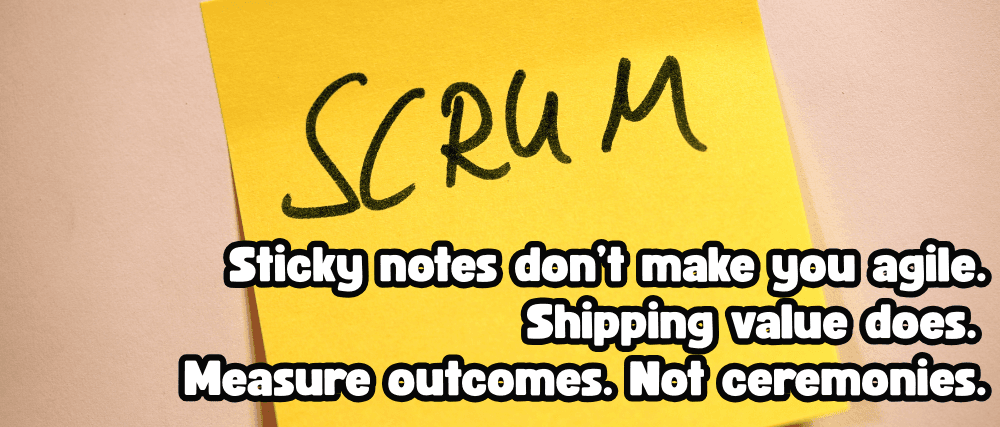
The most common symptom of a FrAgile environment is an obsession with rituals over principles because rituals are easy to audit and principles are hard to live. Scrum, for example, has clear timeboxes. The Daily Scrum is fifteen minutes, Sprints are one month or less, and events like Sprint Planning have maximum durations designed to keep the team focused. Those details are useful until they become the goal. The moment a manager starts evaluating performance by whether the ceremony happened instead of whether the ceremony changed decisions, the organization drifts into theater.
People begin optimizing the wrong things, such as perfect Jira hygiene, immaculate story templates, and full attendance at stand-ups. They produce elegant retrospective lists that nobody acts on. This is precisely why the Agile Manifesto values individuals and interactions over processes and tools. In a healthy Agile system, a sprint is not a two-week cage but a learning loop. A retrospective is not a feelings workshop but a decision-making engine that forces the team to change one concrete behavior. A stand-up is not a status report but a coordination moment. When you see fear in the room, specifically the fear of speaking honestly or surfacing bad news, you can safely assume the rituals have become a mask for an unchanged power structure. The calendar is Agile, but the culture is still command-and-control.
The Leadership Gap
That leadership gap is where most Agile transformations quietly die. Many organizations can get teams to run Scrum because it is relatively straightforward. However, transformation often stops where incentives become uncomfortable, such as the boardroom, budgeting, and performance management. Teams are told to be Agile, yet leadership still demands fixed scope, fixed dates, and fixed costs. These three constraints force teams to pretend certainty exists when it does not.
This produces the most damaging behavior in modern software known as manufactured confidence. Teams pad estimates to survive, product owners convert uncertainty into rigid commitments too early, and managers treat a roadmap like a contract rather than a hypothesis. Meanwhile, leadership often believes they are supportive because they sponsor Agile, while teams experience the opposite. When leadership keeps their old operating system of control and punishment for misses, Agile at the team level becomes irrelevant. You cannot build a learning organization if learning is punished, and you cannot create adaptability if adaptation requires permission.
Measuring Value Instead of Vanity
The tragedy is that the organization often knows what it wants from Agile but measures the wrong signals. The real promise is to move faster and build what matters. Yet Agile Theater replaces these outcomes with vanity metrics that are seductive precisely because they are easy. Managers start looking at velocity, story points completed, utilization, and the number of tickets closed. A team can inflate velocity by slicing work into smaller pieces or gaming estimation, but none of that guarantees customer value.
If you want metrics that resist theater, you need measures that connect engineering activity to delivery reality. That is why DORA metrics became popular. Signals like lead time for changes and deployment frequency are grounded in what reaches production and how safely you operate there. These metrics are much harder to fake than story points because they attach to real system behavior. Pair them with adoption and customer feedback to create an honest scoreboard. The moment an organization shifts from asking how busy they are to asking how quickly they can learn and deliver, the theater lights start to dim.
Escaping the FrAgile Trap
So how do you escape FrAgile in practice, especially in organizations where Agile is happening bottom-up while leadership remains top-down? First, you must accept a truth that many transformations avoid. Bottom-up Agile can improve local execution, but it rarely fixes the system-level constraints that make teams brittle. Real transformation must cross the boundary between delivery teams and decision-makers. Leadership does not need to attend every stand-up, but they must change how they fund work and how they reward behavior.
Second, you must make alignment a concrete artifact rather than a motivational poster. Define what decisions teams can make without escalation, what quality bars are non-negotiable, and what customer outcomes matter this quarter. Third, treat transparency as a design requirement. If bad news travels slowly, your system is already FrAgile. Make blockers visible and make trade-offs explicit.
Finally, remember what Agile actually is. It is not a checklist, a set of meetings, or a vocabulary lesson. Agile is a culture that runs on vulnerability, fast feedback, and the courage to change course before the sunk cost becomes a prison. When that mindset exists, the rituals become lightweight tools. When that mindset is absent, the rituals become heavy armor. If your organization wants to stop being FrAgile, it has to stop acting and start transforming. Align the boardroom with the backlog, replace certainty theater with learning loops, and measure what customers feel rather than what dashboards can easily count. Agile is not something you perform. It is something you become.